

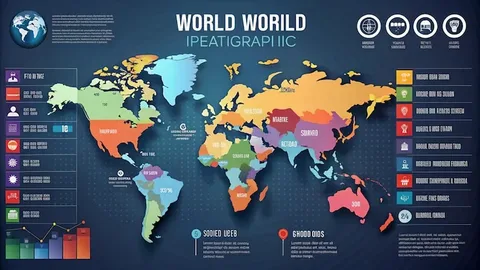
Understanding Mapping the World: From Continents to Countries Explained is essential for students, travelers, educators, and anyone curious about global geography. The world is divided into continents, countries, oceans, and regions, each with unique cultures, landscapes, and political systems. But how did these divisions form? How many continents are there? How many countries exist today?
This complete guide simplifies world geography, explaining continents, countries, borders, and map types in an easy-to-understand way. Whether you’re searching for a world map with countries, how many continents are there, or the difference between political and physical maps, this article will help you grasp the big picture of how our planet is mapped and organized.
What Does Mapping the World Really Mean?
Mapping the world refers to representing Earth’s surface visually through maps. These maps show landmasses, oceans, countries, cities, mountains, rivers, and political boundaries.
Modern mapping combines science, geography, and technology. Today, digital tools like Google Maps allow real-time navigation and satellite imagery, making world mapping more accessible than ever.
Mapping the World: From Continents to Countries Explained in Detail
To fully understand global geography, we must start from the largest divisions and move toward smaller ones.
The Seven Continents of the World
Most educational systems recognize seven continents:
-
Asia
-
Africa
-
North America
-
South America
-
Europe
-
Australia
-
Antarctica
Asia – The Largest Continent
It includes major countries like China, India, and Japan.
Africa – Rich in Natural Diversity
Africa contains 50+ countries and is known for its cultural diversity and natural resources.
Europe – A Hub of History and Culture
Europe consists of around 44 countries and has played a major role in global politics and development.
How Many Countries Are There in the World?
One of the most searched questions on Google is: How many countries are there in the world?
Currently, there are 195 widely recognized countries:
-
193 member states of the United Nations
-
2 observer states (Vatican City and Palestine)
Each country has defined borders, governments, capitals, and political systems.
Political vs Physical Maps Explained
Understanding Mapping the World: From Continents to Countries Explained requires knowing different map types.
Political Maps
Political maps show:
-
Country borders
-
Capital cities
-
Major cities
-
Administrative divisions
These are commonly used in classrooms.
Physical Maps
Physical maps show:
-
Mountains
-
Rivers
-
Deserts
-
Oceans
-
Elevation levels
They help us understand Earth’s natural features.
How Borders Between Countries Are Created
Country borders can be formed by:
-
Natural features (rivers, mountains)
-
Historical agreements
-
Wars and treaties
-
Colonial divisions
For example, many African borders were shaped during colonial rule.
The Importance of Latitude and Longitude
Mapping uses imaginary lines called:
-
Latitude (horizontal lines)
-
Longitude (vertical lines)
These coordinate systems help pinpoint exact global locations.
Digital tools and satellite technology use these coordinates to provide navigation accuracy.
Major Oceans That Shape the World Map
Five major oceans surround continents:
-
Pacific Ocean
-
Atlantic Ocean
-
Indian Ocean
-
Southern Ocean
-
Arctic Ocean
Oceans influence climate, trade routes, and global ecosystems.
Global Regions and Cultural Divisions
Apart from continents, the world is also divided into regions like:
-
Middle East
-
Southeast Asia
-
Eastern Europe
-
Sub-Saharan Africa
These regional classifications are cultural and political rather than geographic.
Technology’s Role in Modern World Mapping
Technology has revolutionized how we map the world.
Satellite systems, GPS, and AI-based mapping tools allow:
-
Real-time tracking
-
Accurate global positioning
-
Disaster monitoring
-
Urban planning
For educational reference, you may explore geographic data from National Geographic (suggested outbound anchor text: world geography resources).
Why Understanding World Mapping Is Important
Learning Mapping the World: From Continents to Countries Explained helps:
-
Students excel in geography
-
Travelers navigate confidently
-
Businesses expand internationally
-
Citizens understand global politics
It improves global awareness and cultural understanding.
Internal Linking Suggestion
You may internally link this article using anchor text such as:
👉 Complete Guide to World Geography Basics
This strengthens your site structure and SEO performance.
Important First-Page Related Keywords
To improve search visibility, include these related keywords naturally:
-
world map with countries
-
How many continents are there
-
List of countries in the world
-
political map vs physical map
-
continents and oceans map
-
World Geography Explained
-
Countries and capitals list
-
globe vs map difference
